| |  | | | Don’t forget to play games! | | |
|
|
| |
|---|
|
In this newsletter | Horse Shark Games | Get Haunted Industries | Arcane Sword Press |
|
|
|---|
|
Horse Shark Games | New Year, New Face | 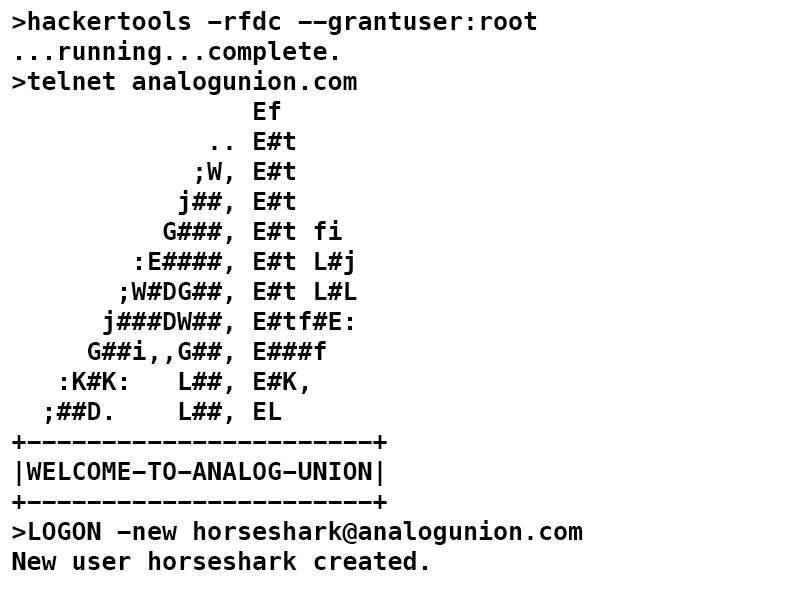 | Horse Shark Games is proud to join the Analog Union! I am James A. Pozenel, Jr. and the creator of Netcrawl RPG, a game where players step into the roles of powerful computer-simulated avatars to battle ICE and AI. I’ve been writing TTRPG content since 2015 mainly for Dungeon Crawl Classics RPG. Horse Shark Games started in 2019 and titles include The House of the Red Doors, Enchiridion of the Computarchs, and the Scions of the Computarchs series. In addition to his original work, I freelance for Goodman Games, Psychoda Press, Bloat Games, and several other publishers, contributing to Dungeon Crawl Classics RPG, Mutant Crawl Classics RPG, and numerous supplements and adventures.
I’d love to connect with you on my Patreon or the Netcrawl discord. I’m of course a big fan of cyberpunk so expect some of that in the coming weeks. I quite excited to be in the Analog Union crew. There’s a strong current of “modern” setting TTRPGs represented. I’m definitely excited to see what we get up to in 2026!
That’s enough about me. I am excited to share early ideas and other musings with you all in the coming months. | | |
|
|
|---|
|
| | Get Haunted Industries | Don’t forget to play games! | | | “To play a game is to meet it on its own terms, not to stand outside it and describe it.” — Ian Bogost, author & game designer
This weekend, I had the absolute pleasure of actually playing in a game. I honestly can’t remember the last time I sat on the other side of the judge’s screen. It’s been at least a year since I was a brave adventurer instead of the adjudicator and occasional dealer of death.
That experience made me stop and reflect on balance: the balance of being a TTRPG enthusiast, creator, collector, player, and judge. The session was only two hours long, but it was a meaningful learning experience. Sure, the judge happened to be a published adventure writer and all-around creative powerhouse, but that’s beside the point. What really hit me was this: if I want to keep learning and growing as a game writer, I need to keep being a game player.
TTRPGs aren’t about me (the writer), they’re about us. They’re about community and collaborative storytelling. If I just hide behind a keyboard pumping out zines, I lose the most important ingredient of all—the player’s perspective. When I think about my favorite gaming sessions, the common threads are always the same: autonomy, meaningful choice, and creative expression.
As writers, we build worlds where we can see exactly what we want to see. But does it translate at the table? Do players care about the set dressing and NPCs we obsess over? Are the clues we plant strong enough to spark curiosity and engagement?
All work and no play makes Joey an ineffective creator. So my New Year’s resolution is officially locked in: play more games and keep the balance alive.
Games I Hope to Play in 2026 - Vampire: The Masquerade
- Top Secret: New World Order
- Every single weird indie TTRPG that comes out of YOUR brains. Let me know (lordbludd@gmail.com) what you are working on and maybe get a boost on Joey Royale’s Pizza Party!
Check out some of my recent pickups: Goons and Ghosts by JP Coovert Netcrawl by James Pozenel Unwinnable Newsletter by Stu Horvath
So let’s get to the table, tell some tales, and GET WEIRD!
|
|
|
|---|
|
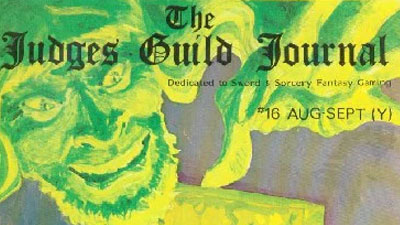
| | Arcane Sword Press |  | I hope you’re interested in reading more about old tabletop magazines! Because I honestly don’t know when I’m gonna stop! This Week, Judges Guild magazines!
For those who don’t know, Judges Guild was a third party publisher of adventure supplements in the early tabletop RPG days, starting up in 1976. They have produced some stonecold classics for AD&D which is what they are best known for. What I like about Judges Guild is how utterly bizarre some of their products are. Some of their releases are truly out of left field and are unlike anything I’ve ever seen.
Some stand out adventures for me are Inferno, Caverns of Thracia, Dark Tower, and Citadel of Fire. They also made some great resources for GMs and players such as books of maps and locations that can be used in your fantasy campaign plus the first game reference screen before TSR made one for D&D. Which honestly, is one of my favorite RPG products. Judges Guild also took on Dave Arneson and published the earliest look we have into the development of the Blackmoor campaign (which inspired D&D) and he wrote for some of their publications!
However, most of their other products really fail to capture the lightning in a bottle with some of those major works of 1970s D&D. Judges Guild also kept printing on newspaper pulp with artwork that literally was traced off of movie posters. Their attempt to diversify into other games like Traveller (which some products are notable!), Chivalry & Sorcery, Tunnels & Trolls, Runequest, etc. didn’t help them stay afloat once TSR stopped licensing out to them and the market pivoted to higher-end print products with better layout, causing them to effectively closed by 1984. However! I absolutely love the high contrast and colorful art they made even if it is copied (heck, OD&D did the same thing!) and has a certain charm that you don’t see in “professional” products. I guess a way to view Judges guild’s output is like a scrappy newsprint zine trying to be a professional product and punching above its weight while being blind to the increase in professionalism in the industry. One could say they were uncompromising, but that ended up being bad for business. | 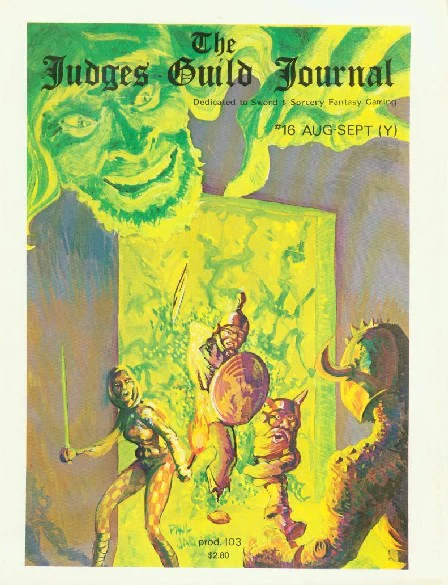 | With that out of the way, I will be looking at the three Judges Guild publications. They are The Judges Guild Journal, The Dungeoneer, Pegasus Magazine. All three of them are a little different than the other, mostly due to the increased production quality if only marginally. If anything, they all seem like a rebrand but with minimal changes. While I haven’t looked at every issue, each one of these had very limited runs of a few years max so it is very feasible to get your hands on them and read the whole run if you really wanted to. The Judges Guild Journal: 25 issues, 1976-1981. This magazine primarily has new dungeons or adventures for players. The deal is that Judges Guild is for the game masters (er, Judges), not the players, so this publication is GM-focused. Oftentimes these dungeons are tersely keyed, as one, one sentence descriptions just saying the treasure and monster. Little to no context, but that was the way they did it in the 70s! The DM is supposed to make it make sense! Some dungeons are much more wordy in other issues, and some even are typed up like a double spaced school paper! Some very funny inconsistencies! But there are some gems! In this issue, Richard Forester talks about playing the iconic Giants modules G1-2-3. The way it’s written is pretty fun, it’s less of a review and more of an adventure report about their exploits. This was a primary way for GMs to learn about other modules coming out or to see how the adventures played out at other tables. The main issue is that all of the type is blocks of typewriter typeface, and sometimes it’s poorly pasted onto the print masters, making some pages look crooked. The Journal also had minimal ads in it in the early days, so you’d find curious spot art to fill in the large gaps. The Dungeoneer: 1977-1980, 19 issues. Next, Judges guild attempted to make a publication both for players and referees and is more typical of something like Dragon Magazine, but not quite there yet. Actually, this one started as a fanzine at a college that Judges guild then took on as a supplemental release with Journal. In addition to a few dungeons here and there. The Dungeoneer also includes a few periodicals on alternative spells and treasure, plus articles on advice and reviews. Nothing mindblowing but an interesting look into how people looked at the hobby at the dawn of AD&D. At least the typeface and layout is better! Pegasus Magazine: 1981-1983, 12 issues, with a 13th never formally published. The Final publication Judges guild invested in it before vanishing by the mid 80s. It was the evolution of The Dungeoneer and was the best effort from Judges guild to make a magazine like The Dragon. However, there isn’t anything new here beyond some of the usual Judges Guild charm with regards to adventure ideas and magic item periodicals. What I DO like is the reviews they have, which cover games and products that you don’t typically find or lesser known gaming companies that seem to be forgotten at this point.
Judges Guild has its own charm, and is shockingly easy to find. There is countless deadstock of the less popular Judges Guild products for purchase on online vendors and even the used stuff comes in extremely affordable lots. It’s all printed in newsprint, so the books are prone to quick wear and tear if you’re not careful! It’s not worth supporting the current Judges Guild due to the problematic current owner, but luckily the Internet Archive can provide a look into the curious corner Judges Guild occupied at the birth and transitional times of the hobby from underground adult-aged gamers to mainstream kid-friendly products. That’s it for now! Next Week- The Space Gamer by Metagaming Concepts & Steve Jackson Games (and a bunch more!) |  | Looking for a last minute Christmas Present for a nerd in your life (or for yourself)? Fanatical has a Classic Traveller PDF deal where you can get the entire line of the original run of Classic Traveller for $16! Whoa! You can check it out here |
|
|
|---|
|
Your editor this week has been Jayson Elliot of Solarian Games.
Keep on emailing us at hello@analogunion.com to let us know what you’d like to see more of, less of, or just ideas you’ve got. If you like the Analog Union newsletter, please tell your friends to sign up at AnalogUnion.com. See you next week! -Jayson |
|
| |
|---|
|
|
|